UX Debt Is More Dangerous Than Technical Debt
UX Debt Is More Dangerous Than Technical Debt. UX debt accumulates quietly.

Chemss Salem

Welcome to Chems Labs a mini-series about real-world UX, complex systems, and the decisions that shape experience beyond interfaces.
UX Debt Is More Dangerous Than Technical Debt
“UX debt accumulates quietly.
Unlike technical debt, it rarely causes immediate failure. Instead, it shows up as workarounds, spreadsheets, training documents, and support dependency.
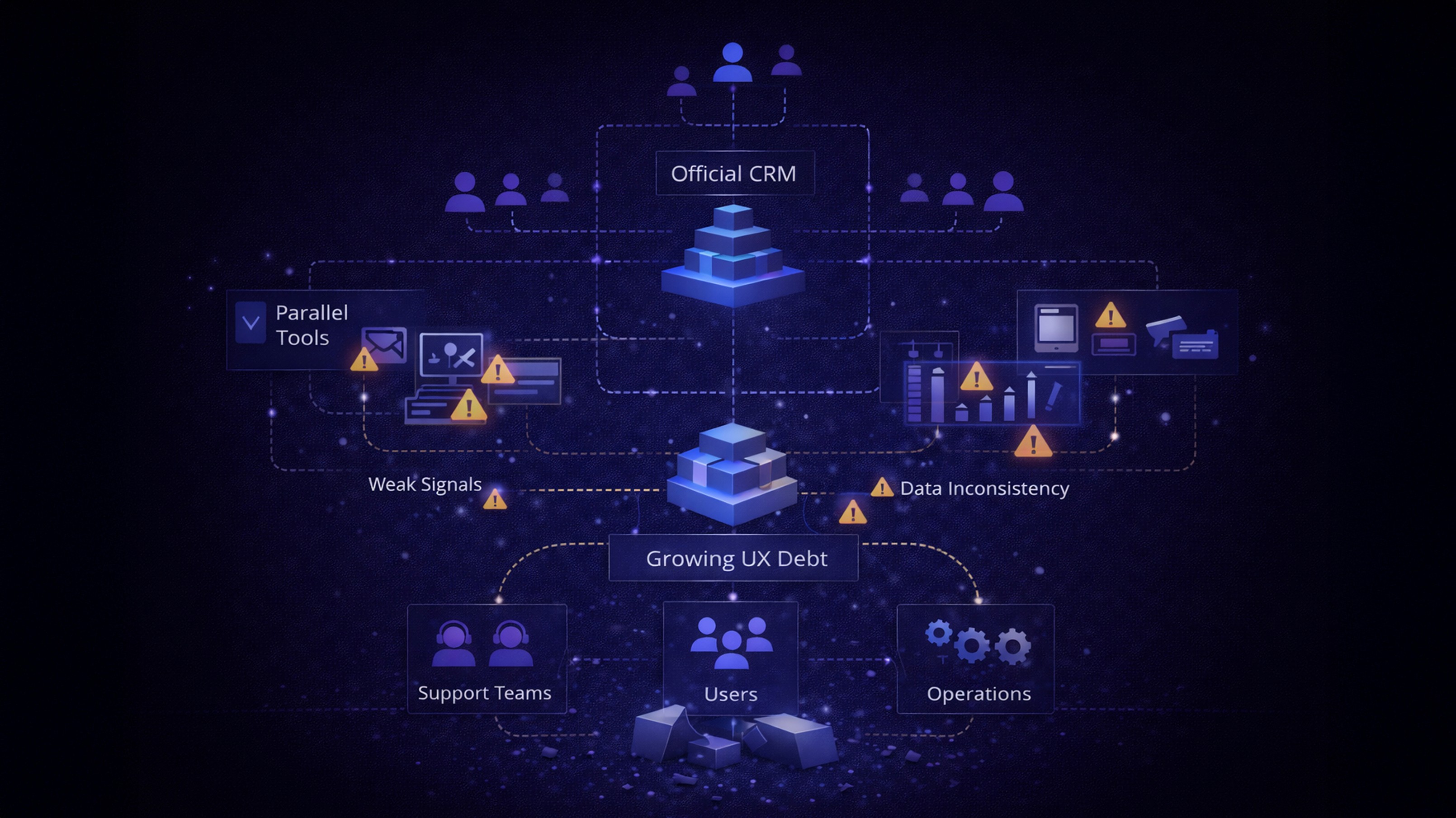
In an enterprise CRM, users gradually abandoned official workflows in favor of parallel tools. Over time, data inconsistencies emerged, reporting broke, and operational risk increased. What began as small UX compromises became systemic instability. UX debt grows when teams repeatedly postpone structural decisions in favor of short-term delivery.
And unlike technical debt, UX debt is often paid by users, support teams, and operations not by the teams that created it.
Managing UX debt requires recognizing experience erosion as a decision problem, not a design flaw.
Next episode: design systems.”
© by Chemsseddine SALEM | Lead UX Designer & Researcher | Enterprise SaaS & UX Strategy | UX Governance | Finance & Energy Sectors | 2026