Designing for Complexity: Leading UX in Data-Driven Enterprise Ecosystems
Why simplicity is a luxury, systems thinking is survival, and the UX leader's real job is sense-making at scale

Chemss Salem
Anyone who has spent serious time inside a large banking platform, an energy management system, or a government regulatory portal knows that simplicity is not the default state of these environments. It is, at best, something you fight for on every sprint cycle.
Behind every button in a genuine enterprise system lies a forest of APIs, data pipelines, permission hierarchies, and competing business priorities. What looks like a single product from the outside is, from the inside, an ecosystem in constant motion, a shifting network of systems, people, and data that nobody designed as a whole because nobody could. It grew. It accreted. And it is still growing.
The UX challenge in these environments is not interface design. That is the last 10 percent. The real challenge is making sense of complexity, creating clarity, trust, and operational coherence in conditions where information density and business logic actively work against the user's ability to understand what is happening and what they should do next.
This is what it actually means to lead UX in data-driven enterprise ecosystems. Not polishing screens. Translating systems.
CORE ARGUMENT
Enterprise UX is not a design discipline applied to complex products. It is a strategic capability that determines whether organisations can use their own systems effectively. The UX leader's primary function in these environments is not creative direction, it is sense-making: helping humans stay oriented in systems too complex to hold fully in mind.
1. The Three Layers of Enterprise Complexity and Why Each Requires a Different Response
Complexity in enterprise environments is not monolithic. It presents in three distinct forms, each with different causes and different UX responses. Conflating them is one of the most common reasons enterprise UX programmes underdeliver.
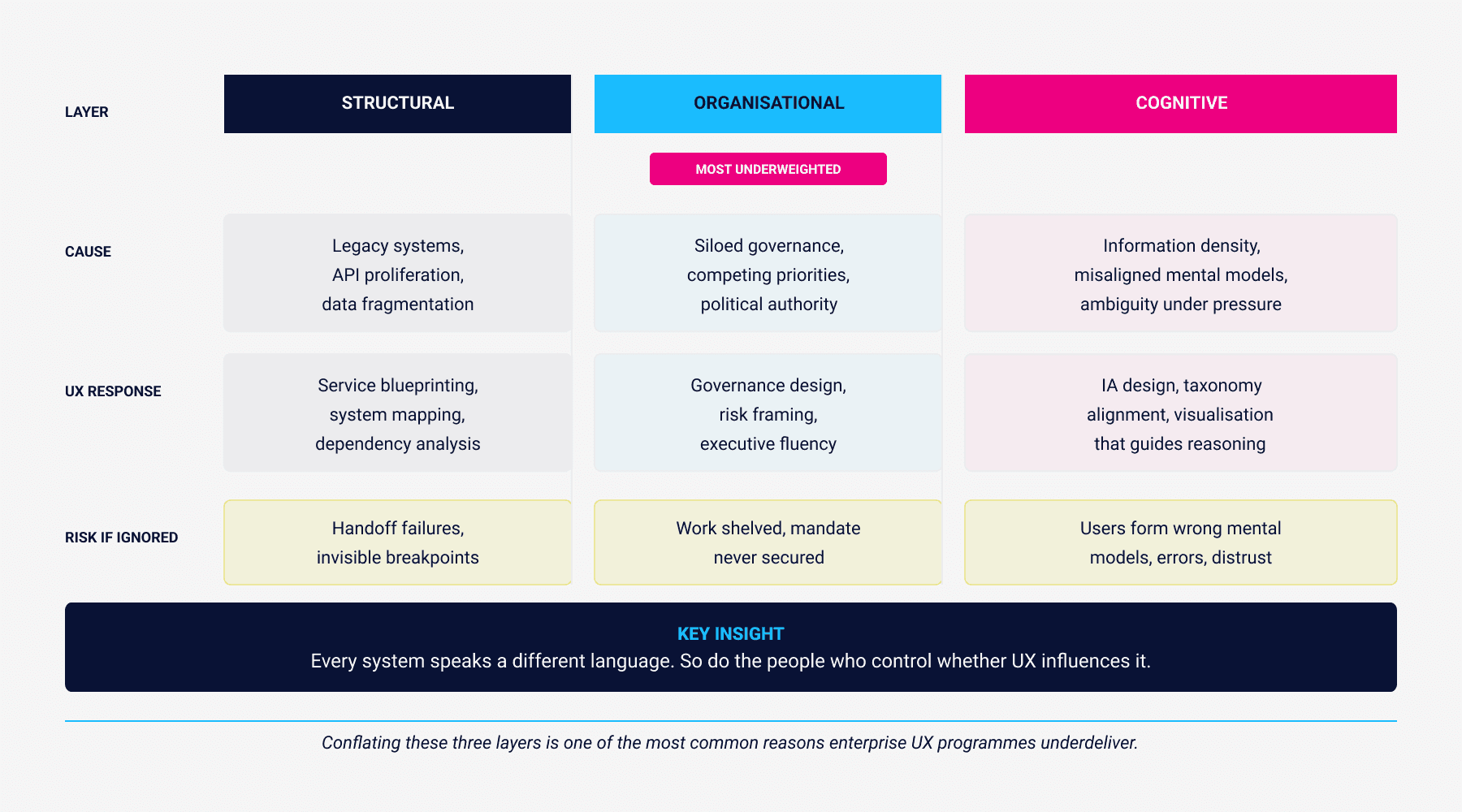
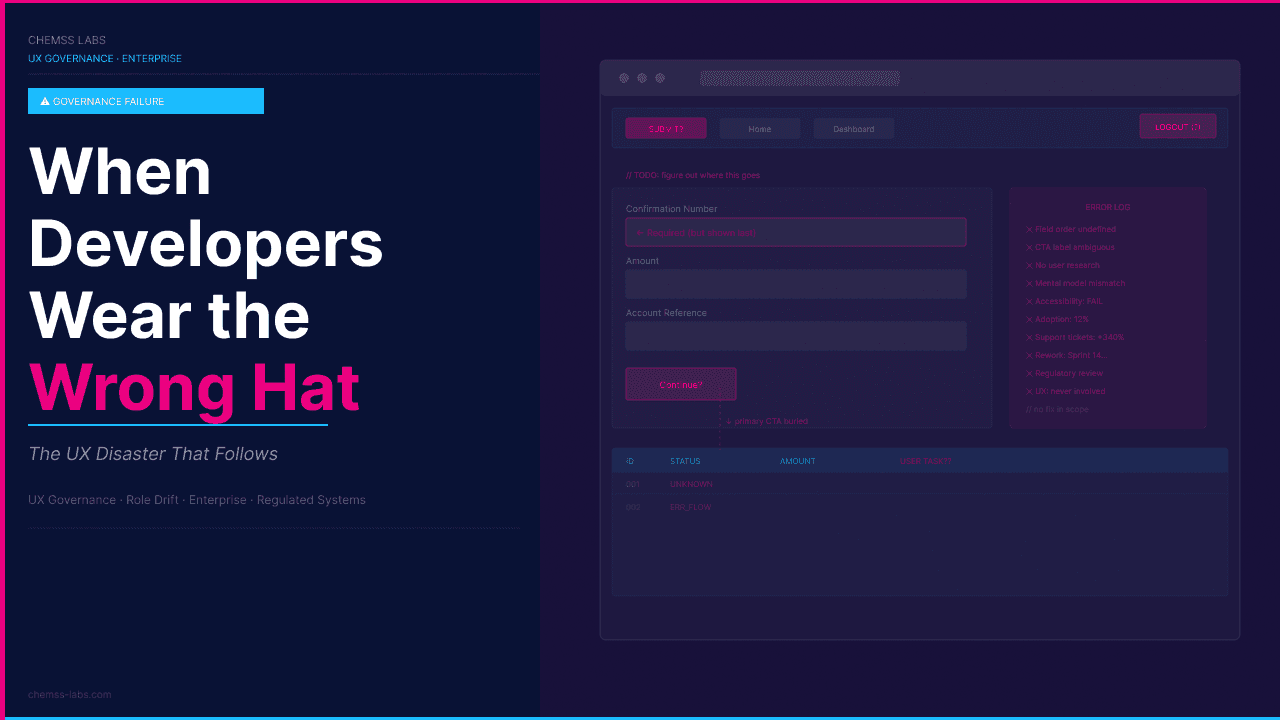
The organisational layer is the one that most UX frameworks underweight. In energy infrastructure and financial services programmes, I have seen technically excellent design work, well-researched, properly validated, clearly documented shelved because no one with governance authority was involved until the work was already done.
Every system speaks a different language. That is the structural problem. But the people who control whether UX has any influence over those systems also speak a language, one of risk, compliance, cost, and delivery velocity. Until UX leaders become fluent in that language too, the work stays in the design tool.
2. Systems Thinking: Why User Journeys Are Not Enough
The standard UX toolkit, personas, journey maps, wireframes, usability testing, is essential but insufficient in enterprise contexts. These methods were developed for products with defined user populations, clear task boundaries, and manageable scope. Enterprise ecosystems are none of those things.
In a single energy billing exception, five different actors interact with five different systems, and no single actor sees the full picture. A field technician logs an anomaly. An operations analyst flags it. A billing manager approves an adjustment. A compliance officer audits it. A customer eventually receives a corrected bill. The UX of each touchpoint is individually manageable. The UX of the system, the coherence of the whole, is what most programmes never actually design.
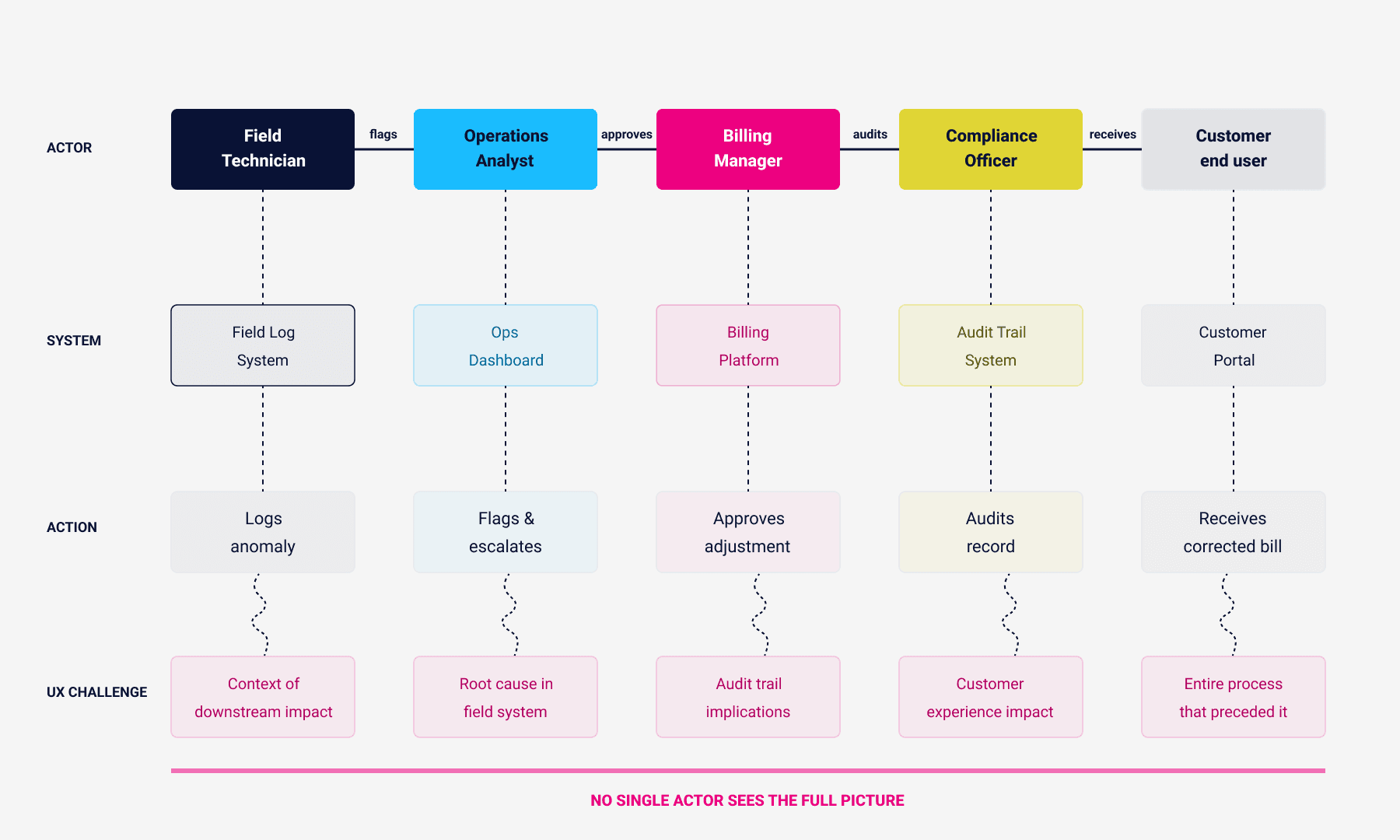
The design question in these environments is not "what is the user's journey?" It is "how do these actors coordinate meaning through the system?" The distinction matters because the answer to the first question produces a journey map. The answer to the second produces a service blueprint, a fundamentally different artefact that traces dependencies, surfaces handoff failures, and maps the invisible infrastructure that determines whether the visible experience works.
In energy, telecom, and government programmes I have worked on, service blueprinting consistently surfaced failure points that no individual team was aware of, because each team was only ever looking at their own section of the flow.
3. Data Does Not Equal Insight and the Difference Is Everything
Most enterprise organisations assume that more data leads to better design decisions. In practice, it often produce the opposite, data paralysis, confirmation bias, and analysis that generates activity without generating understanding.
The organisations I have worked with closest in financial services and energy have no shortage of metrics. What they consistently lack is synthesis, the disciplined practice of connecting quantitative signals to qualitative understanding to business impact.
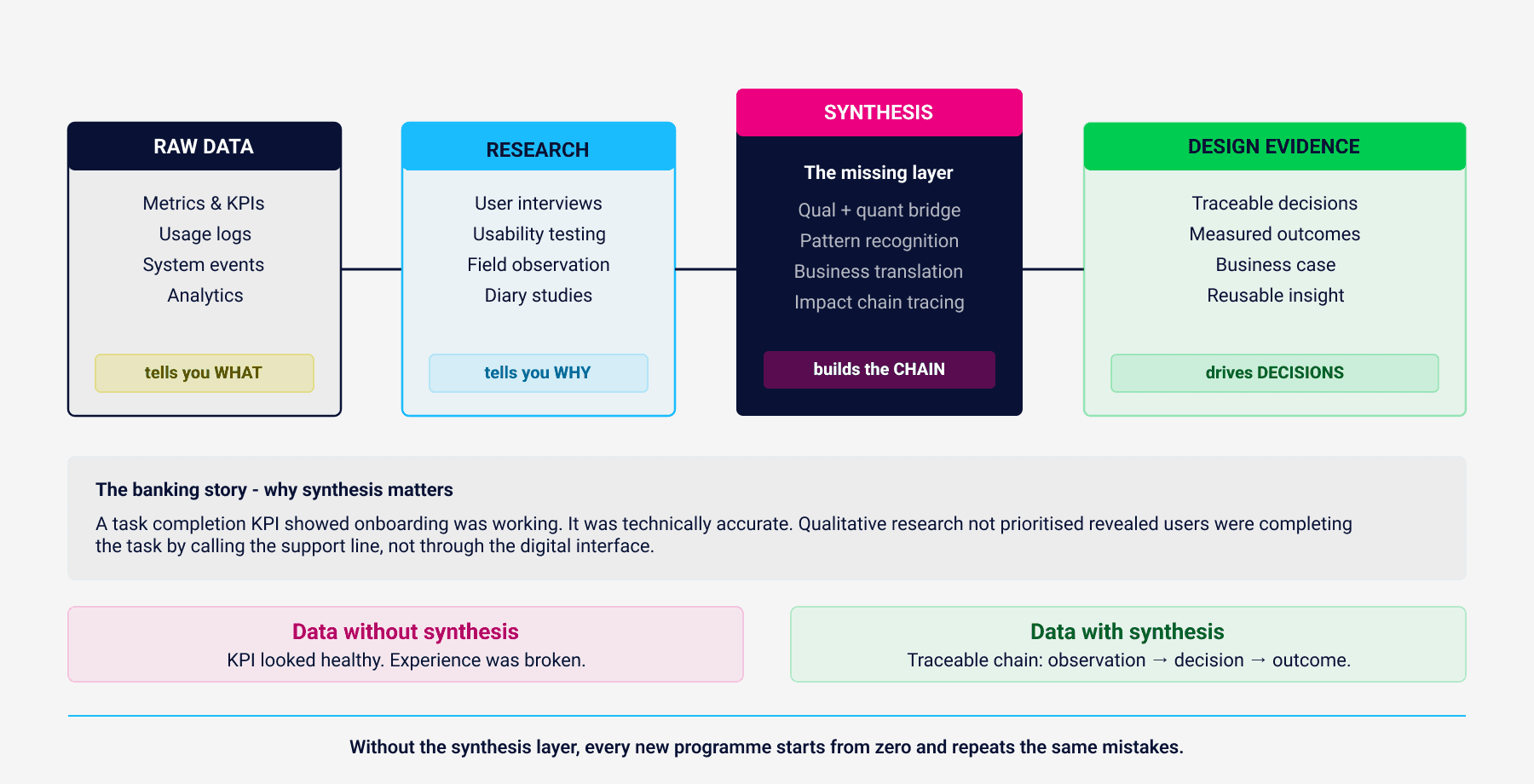
Without that synthesis layer, analytics tells you what is happening but not why. Research tells you why but has no connection to the business language leadership speaks. KPIs tell you what leadership cares about but bear no traceable relationship to what users are actually experiencing.
The bias of abundance is a real problem in data-rich environments. The more metrics a team has access to, the more likely they are to select the ones that confirm the decision already made. The UX leader's job in these conditions is to protect the integrity of interpretation to ensure that evidence informs decisions rather than decorates them.
In a banking programme context, I watched a product team use a task completion metric to argue that their onboarding flow was working. The metric was technically accurate. But the qualitative research which they had not prioritised showed that users was completing the task by calling the support line rather than through the digital interface. The KPI looked healthy. The experience was broken.
THE SYNTHESIS PROBLEM
Data without interpretation is noise. Research without connection to business metrics is opinion. The UX leader's role in enterprise environments is to build the synthesis layer — the traceable chain from observation to design decision to measured outcome. Without it, every new programme starts from zero.
4. Information Architecture as Cognitive Infrastructure
In every enterprise system I have worked on, the single most consequential design decision is the information architecture. Not the visual layer. The IA how concepts are named, grouped, sequenced, and surfaced to users.
The reason this matters so much in regulated environments is that terminology is not neutral. In a government benefits platform, the difference between calling something a 'claim' versus an 'application' can affect whether a user understands they need to act. In a trading risk dashboard, whether a threshold appears as a percentage or an absolute value determines whether a trader sees risk accurately in a fast-moving market.
These are not aesthetic decisions. They are cognitive infrastructure decisions choices about how the system helps users form accurate mental models of what they are interacting with.
The semantic mediation problem
In large enterprises, different departments routinely use different terms for the same concept. Finance calls it a 'disbursement.' Operations calls it a 'payment run.' The system stores it as a 'transaction batch.' The user sees a label that reflects whichever team's vocabulary was adopted at system build which is usually the engineering team's vocabulary, which reflects the data model, not human cognition.
UX teams in these environments are semantic mediators as much as they are designers. The work of aligning taxonomy across departments is unglamorous, politically charged, and absolutely critical. It is also the work that most programmes defer until it becomes a crisis.
Visualisation is not the same as comprehension
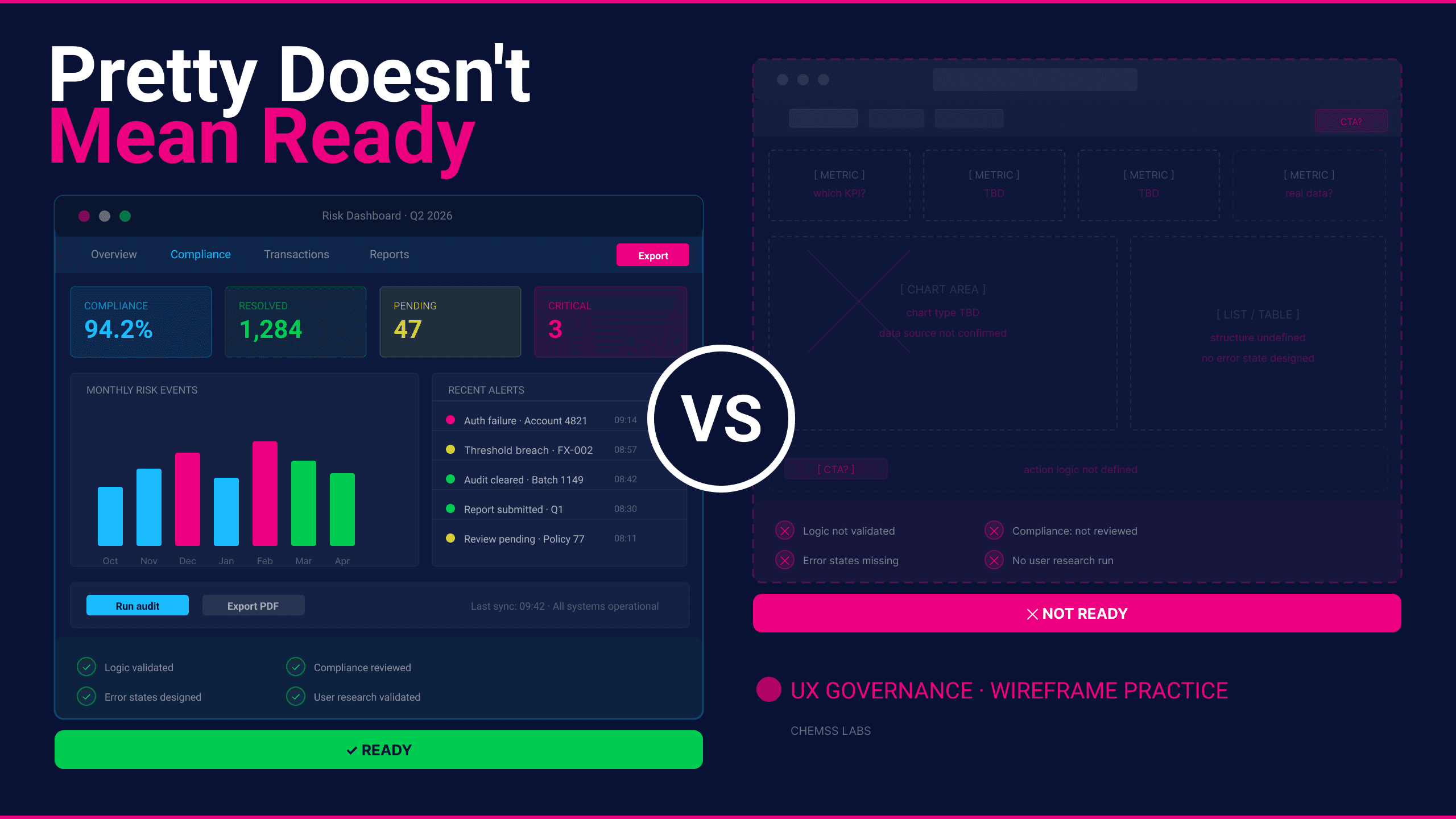
Data visualisation in enterprise environments is treated as the prestige deliverable the dashboard that gets shown to the executive committee. The real craft, which is far less visible, is designing interfaces that help users form accurate reasoning about what they see.
A beautiful dashboard that does not drive understanding is decoration. The most effective enterprise visualisations guide reasoning they show relationships, causality, and change over time. They highlight anomalies without requiring the user to hunt for them. They integrate narrative cues that help users form the right questions before they form premature conclusions.
5. The Three Literacies of Enterprise UX Leadership
Through direct involvement in enterprise transformation programmes across financial services, energy, and government, three interdependent competencies emerge as the foundation of effective UX leadership in these environments. The absence of any one of them creates a ceiling on what UX can achieve.
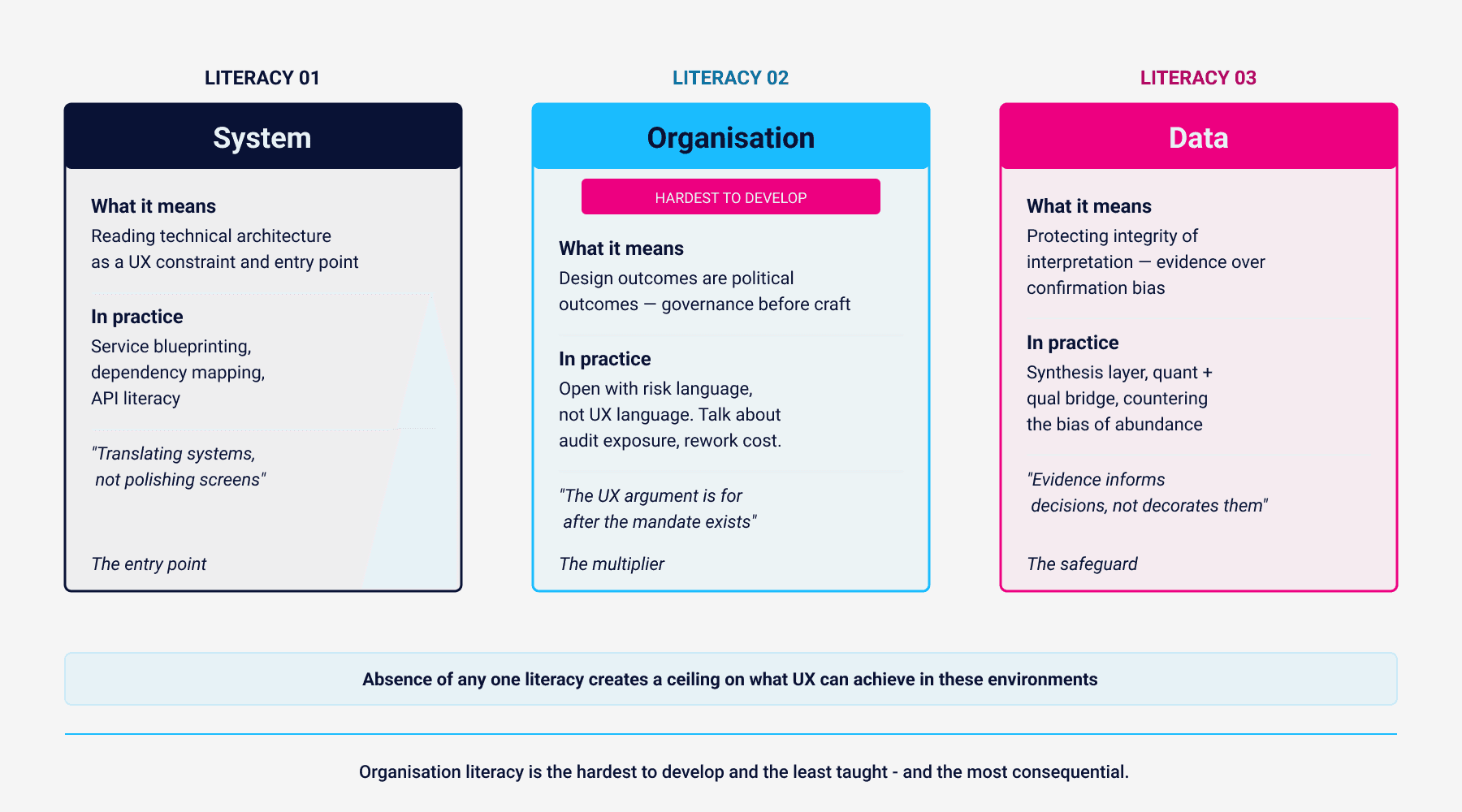
Organisation literacy is the hardest to develop and the least taught. It requires understanding that in most regulated enterprises, design outcomes are political outcomes and that influencing a design decision often means influencing the metrics conversation that precedes it, not the design review that follows it.
The practical implication: when arguing for a UX governance framework to a programme director in a banking transformation, do not open with user experience language. Open with risk language. Talk about audit exposure, regulatory friction, and the cost of assumption-driven design that surfaces as rework in sprint 14. Those are the terms that secure governance mandates. The UX argument is for the conversation after the mandate exists.
6. AI, Automation, and the UX Responsibility for Trust
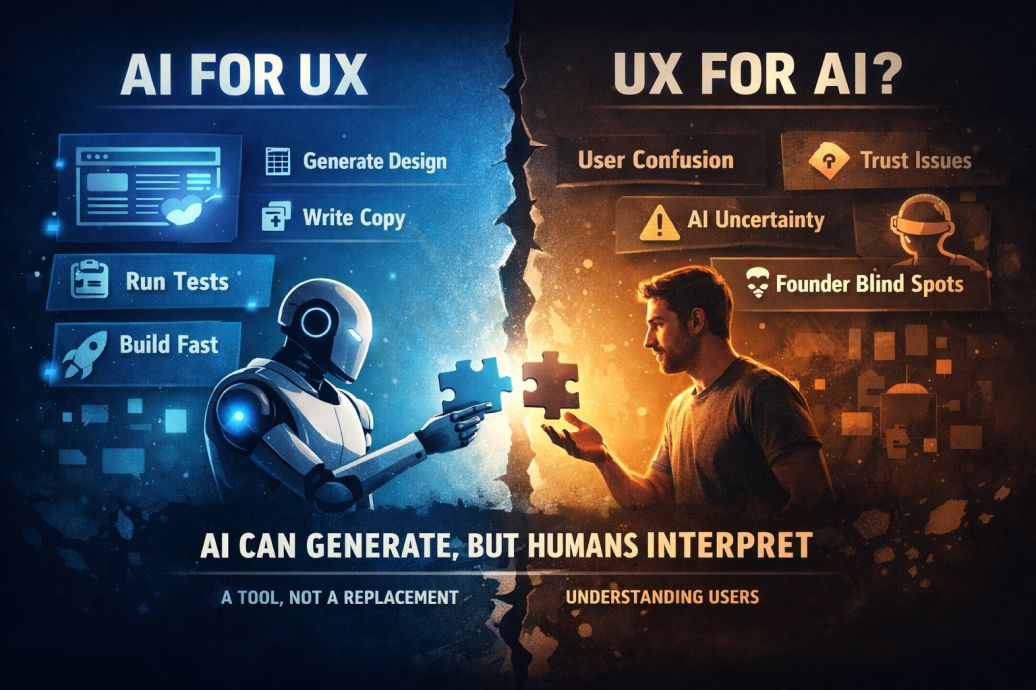
As financial services, energy, and government platforms embed AI-driven decisioning more deeply into their operations, UX faces a category of responsibility that goes well beyond usability. It is about whether users can maintain meaningful agency in systems that increasingly act on their behalf without asking.
This is not a speculative concern. In credit risk platforms, AI recommendations already shape lending decisions. In energy management systems, automated alerts determine operational responses. In government benefit systems, algorithmic scoring influences eligibility outcomes. Users interact with these systems at consequential moments often without visibility into the logic driving what they see.
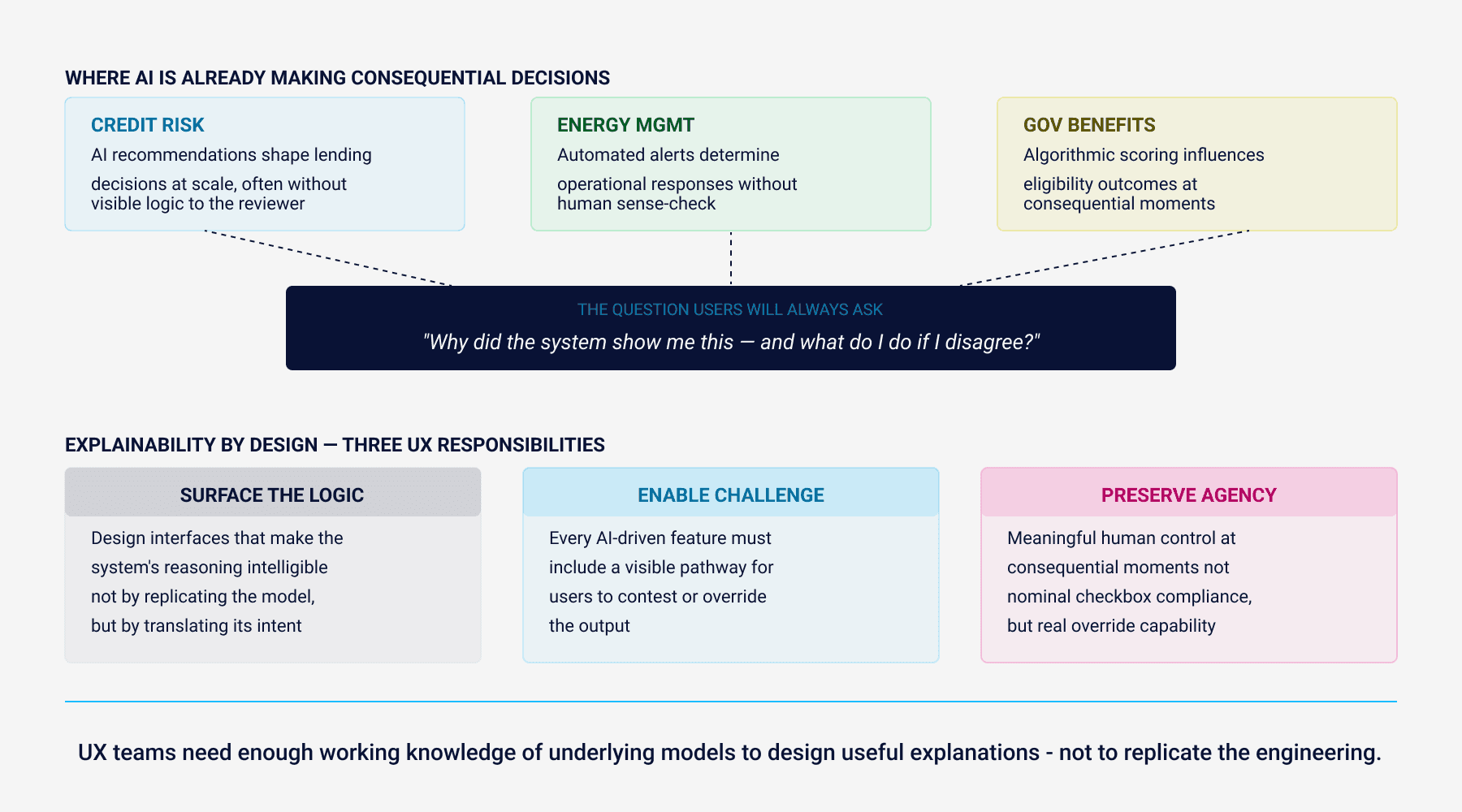
The principle of explainability by design means that every AI-driven feature in a regulated system should be conceived from the start with a UX layer that answers the question users will eventually ask: "Why did the system show me this, and what do I do if I disagree?"
In practice, this means UX teams need enough working knowledge of the underlying models to design useful explanations not to replicate the engineering, but to make the system's reasoning intelligible to the humans who have to act on it.
7. Measuring UX Impact: From Interface Metrics to Strategic Outcomes
One of the most consistent questions I receive from programme boards and executive stakeholders in enterprise environments is how to measure UX impact. The honest answer is that it depends on where the organisation is in its UX maturity and that most organisations are measuring at the wrong level.
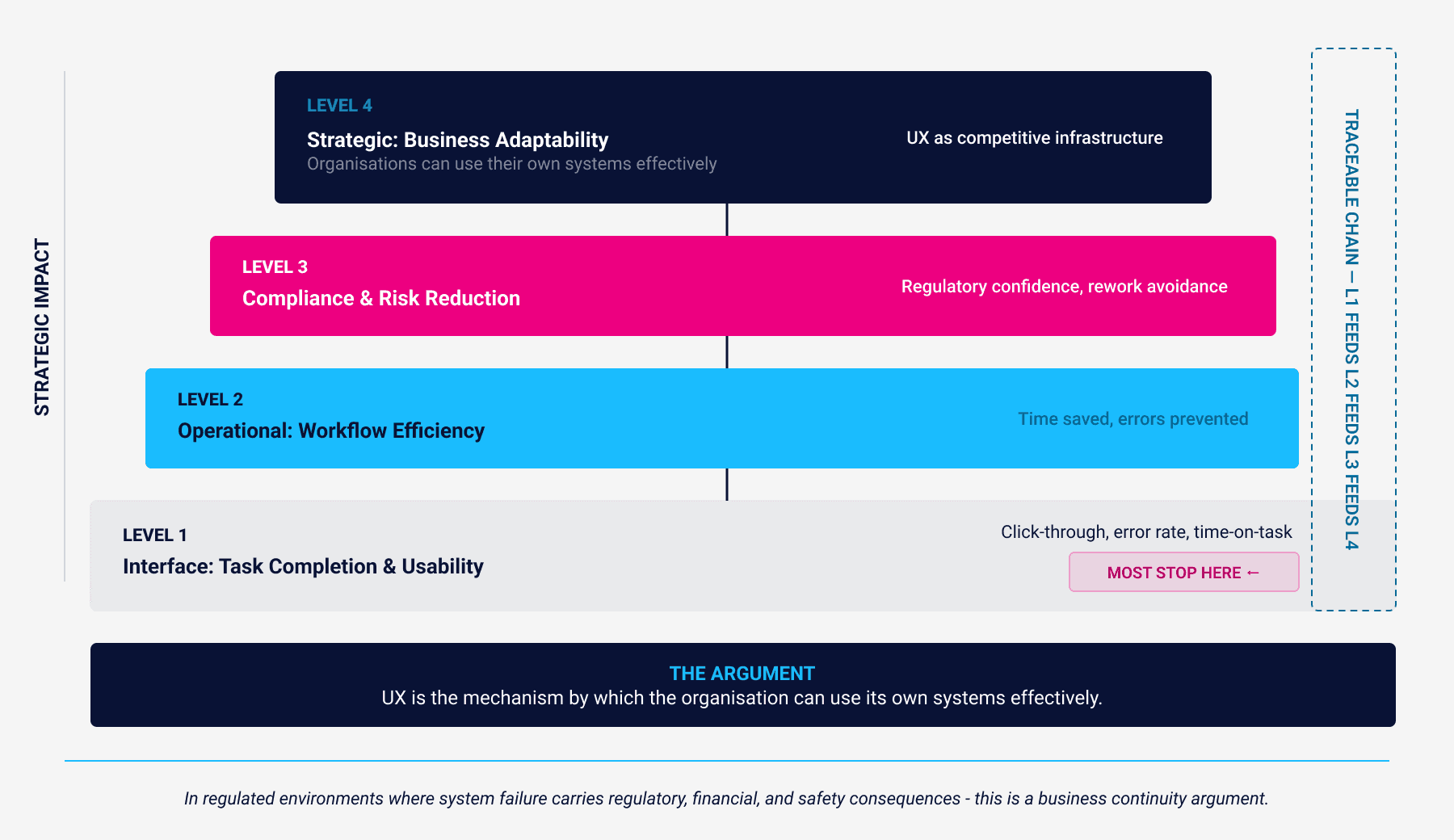
The UX leader's task is to connect these levels to show that task completion rates at Level 1 directly feed into workflow efficiency at Level 2, which directly reduces compliance risk at Level 3, which directly improves business adaptability at Level 4. The argument is not that UX is valuable in the abstract. The argument is that UX is the mechanism by which the organisation can use its own systems effectively.
That is a business continuity argument. In financial services, energy, and government environments where system failure carries regulatory, financial, and in some cases safety consequences, it is the most compelling argument UX leaders have.
8. Leading Through Complexity: The Real Function of the UX Director
Design leadership in enterprise environments is not creative direction. It is organisational sense-making the work of helping large, siloed institutions see the whole when every team is focused on its own part.
That means building the research infrastructure that keeps insight alive beyond individual projects. A UX team that produces excellent research and stores it in a project folder has not created institutional knowledge it has created a document archive. DesignOps and ResearchOps, properly implemented, are the mechanisms that transform individual project findings into a compounding body of evidence that every subsequent team can build on rather than duplicate.
Building resilient teams in ambiguous environments
Complexity is mentally expensive. Designers who spend sustained periods navigating ambiguity, conflicting stakeholder priorities, and systems that resist understanding will burn out if the leadership environment does not actively counteract it.
Strong enterprise UX leaders invest in cognitive clarity the structure that gives designers enough orientation to do their best work amid chaos. That means clear problem framing, visible decision records, and psychological safety to question assumptions without it being read as obstruction.
It does not mean protecting teams from complexity. That is impossible. It means giving them the scaffolding to work inside complexity without being consumed by it.
Influence without authority
In enterprise programmes, UX leaders rarely have formal authority over the decisions that most determine design outcomes budget allocation, scope prioritisation, governance structures. They operate in the space between influence and mandate.
The discipline of framing UX goals in the language of the audience is not a soft skill. It is the core competency of enterprise UX leadership. Don't talk about usability to an operations director talk about workflow efficiency and error rate reduction. Don't argue for research time to a programme manager argue for risk reduction and rework avoidance.
The UX argument is sound. The question is always whether it is being made in a language the listener can act on.
9. Complexity Is the Medium, Not the Problem
The organisations that consistently produce enterprise systems people can actually use are not the ones that successfully simplified their complexity. No serious financial platform, energy management system, or government regulatory environment is ever truly simple. The complexity is structural. It will not be designed away.
What those organisations did is build the UX infrastructure that makes complexity manageable service blueprints that surface the whole picture, design systems that provide consistency under delivery pressure, research operations that keep institutional knowledge alive, and governance frameworks that give UX the authority to hold the line when shortcuts are proposed.
The UX leader's role in these environments is shifting from problem-solver to sense-maker from crafting individual interactions to shaping how the organisation itself thinks about data, evidence, and user impact. That is a different kind of work. It requires different skills, different political fluency, and a different understanding of where design decisions are actually made.
Complexity is not the enemy. It is the medium. The challenge is to make that medium intelligible, humane, and responsible at scale, under pressure, and in environments where the cost of getting it wrong is measured in more than user frustration.
CLOSING STATEMENT
The organisations that build enterprise systems people can trust are not the ones with the most sophisticated technology. They are the ones where UX has the governance authority, the research infrastructure, and the cross-functional fluency to keep human reasoning at the centre of decisions that are increasingly being made by machines
About the Author
Chemsseddine SALEM is a Lead UX Designer and Researcher specialising in Enterprise SaaS, UX Governance, Finance, and Energy sectors. He is the founder of Chemss Labs and works with organisations navigating large-scale digital transformation in regulated environments.
About


Featured Posts