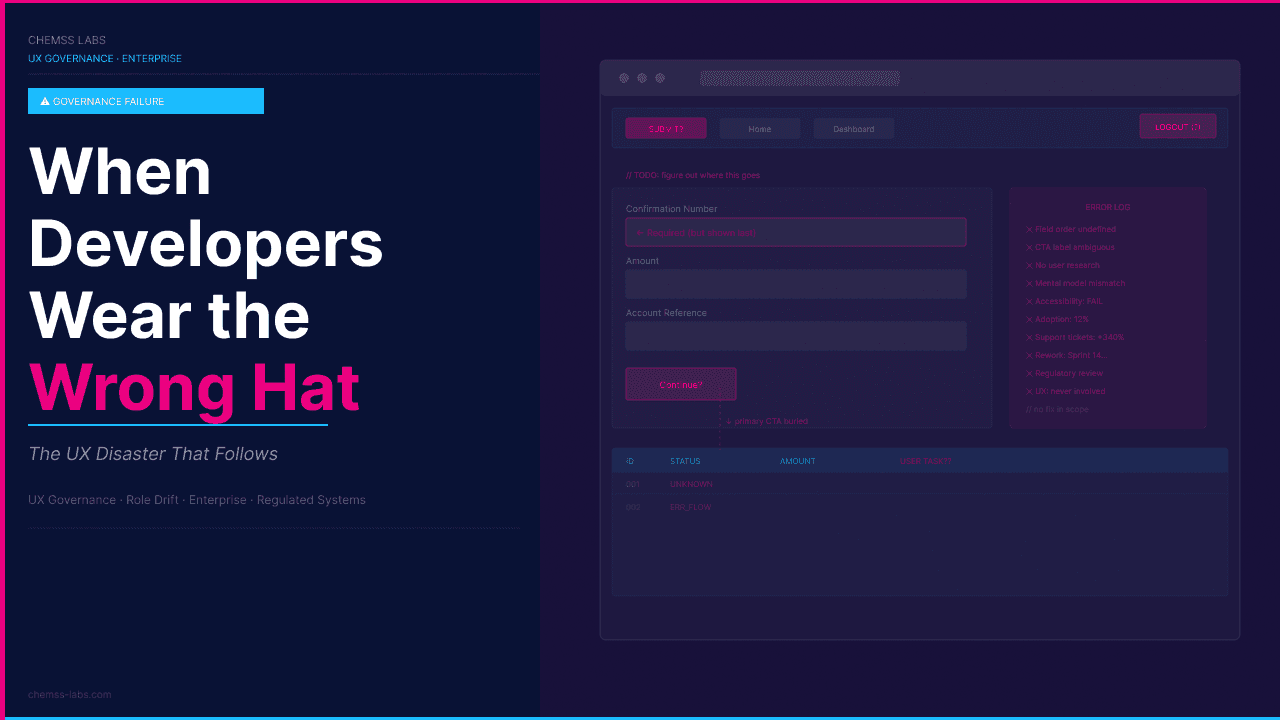
Pretty Doesn't Mean Ready
How Misusing Wireframes Breaks UX Strategy in Regulated Industries

Chemss Salem
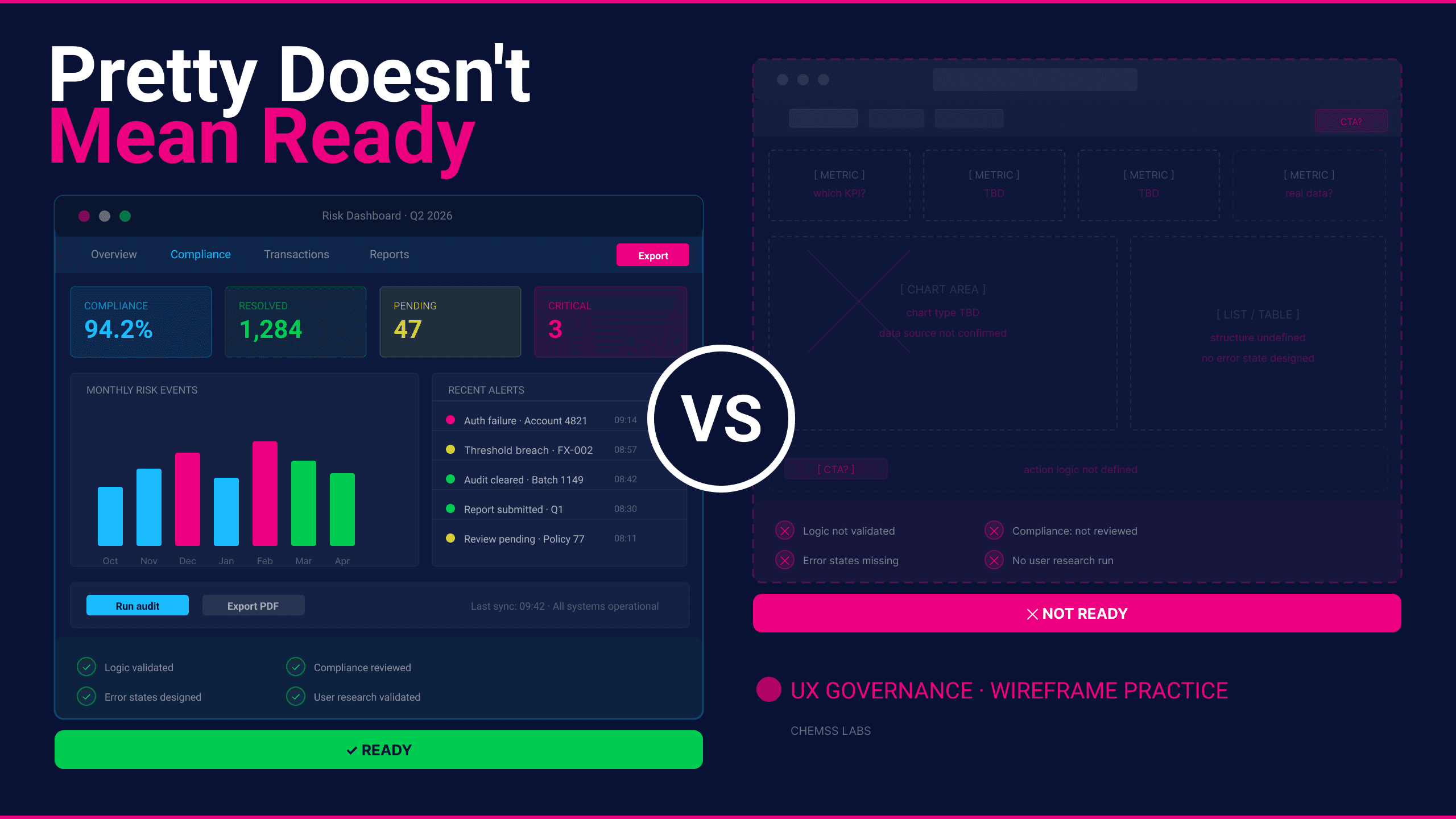
There is a moment every UX team dreads, even if they don't name it. The wireframes look good. Clean, aligned, seemingly purposeful. The stakeholder nods. The project manager breathes. And then, three months later, the development team is rebuilding screens because the logic was never actually validated only the visuals were admired.
In banking, energy, telecom, government, and public sector programs, this is not an edge case. It is a recurring pattern that quietly destroys timelines, erodes trust between UX and engineering, and in the worst cases triggers compliance failures that no amount of beautiful UI can fix.
I've been embedded in large-scale enterprise environments for two decades. The pattern repeats. A wireframe that look finished is not the same thing as a wireframe that is ready. The confusion between the two is not a design problem. It is a governance problem.
CORE ARGUMENT
Wireframes are decision-making instruments. When teams treat them as marketing assets, UX strategy breaks. The cost is not aesthetic it's financial, operational, and in regulated industries, potentially legal.
1. Wireframes Were Never Meant to Impress
This is the thing most stakeholders in regulated industries fundamentally misunderstand, because they are used to deliverables that represent finished thinking. A procurement document is final. A regulatory submission is final. An architecture diagram, once approved, is a commitment.
Wireframes operate in a completely different register. Their purpose is not to communicate completion it is to surface ambiguity before it becomes expensive.
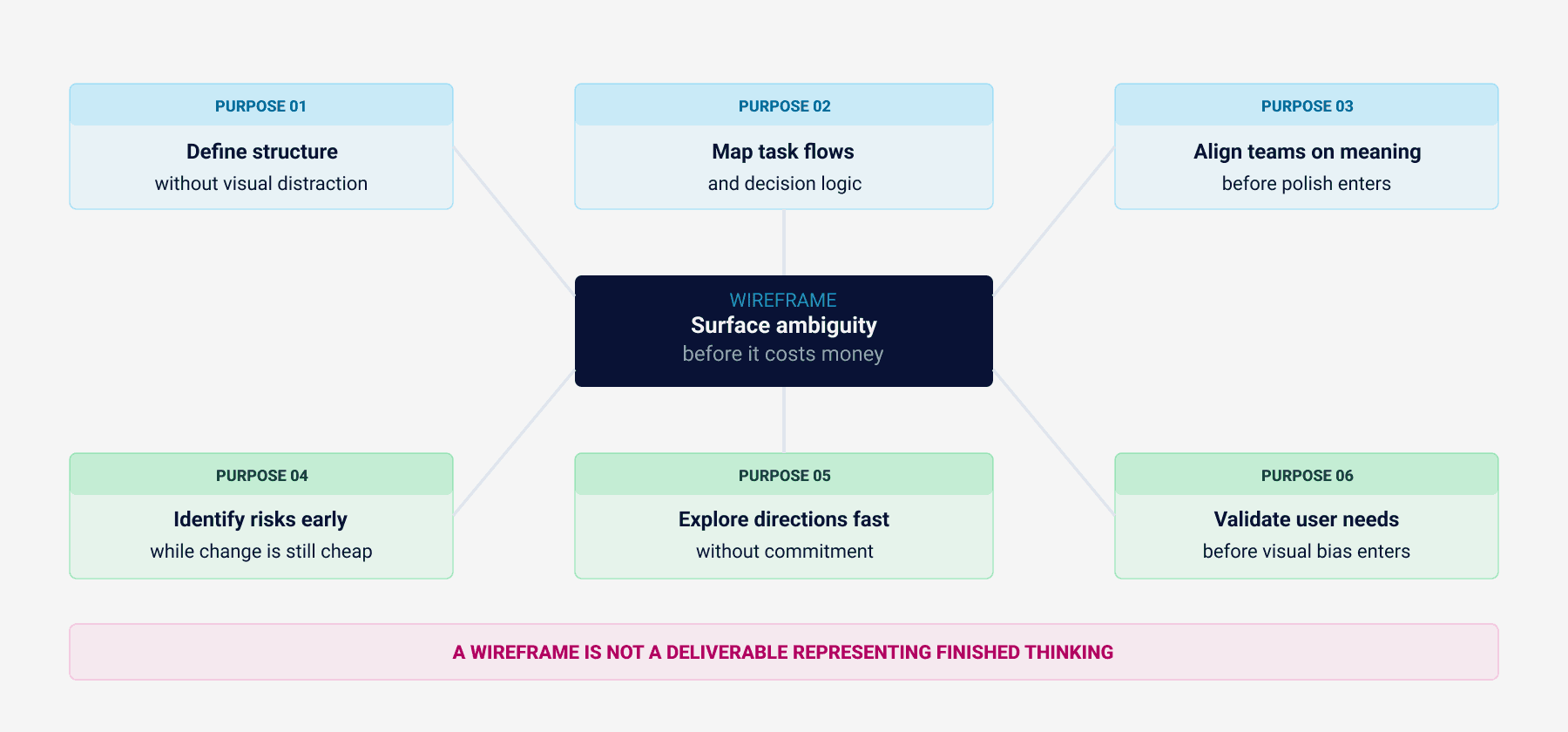
What a wireframe is actually designed to do:
Define structure and hierarchy without visual distraction
Map task flows and decision logic across user journeys
Align cross-functional teams on meaning before polish enters the room
Identify risks, missing states, and logical gaps while change is still cheap
Create space to explore multiple directions fast, without commitment
Validate user needs before the visual layer introduces cognitive bias
In enterprise programs particularly in financial services, energy operations, and government portals wireframes tend to get promoted into pseudo-designs the moment they look credible. Someone polishes the spacing. Someone else adds a real icon. A brand color creeps in. And suddenly the room stops questioning the logic and starts debating the interface.
When that shift happens, the design process collapses into decoration.
2. The Five Ways Over-Designed Wireframes Break Enterprise Programs
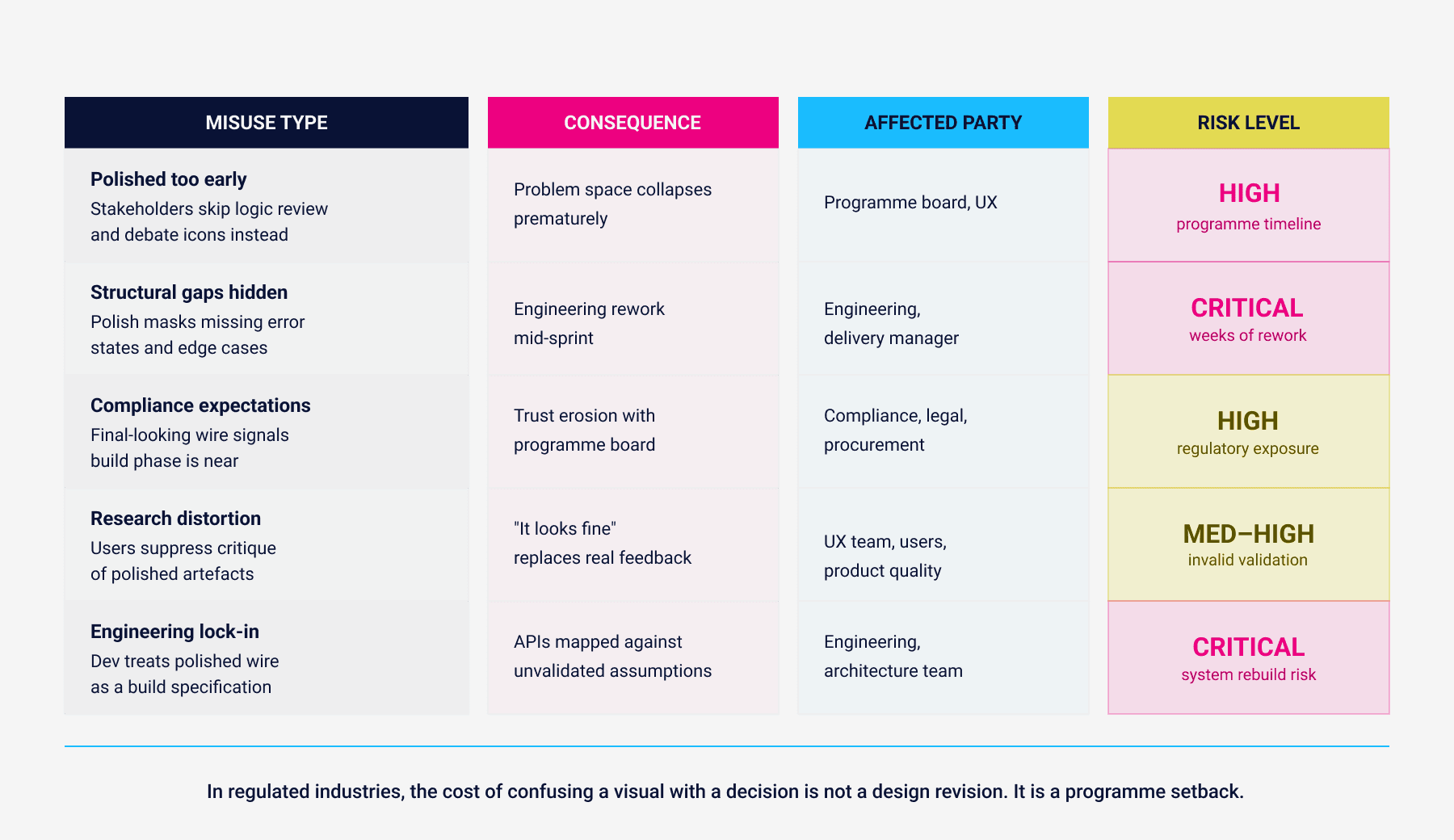
2.1 They fast-forward stakeholders into solution mode
High-fidelity wireframes activate a very specific executive reflex. In banking and energy governance structures, stakeholders are trained to react to finished artefacts they approve, reject, or escalate. Show them a polished wireframe and they instinctively treat it as a deliverable requiring a decision.
Instead of asking the right questions:
"Does this workflow support our regulatory reporting requirements?"
"What happens when the API call fails during a customer transaction?"
The room drifts toward:
"Can we use our updated icon set here?"
"Why isn't this screen responsive yet?"
The problem space collapses prematurely. You polished yourself out of the exploration phase.
2.2 They hide deep structural weaknesses
A polished wireframe can camouflage unclear flows, missing states, and fundamentally flawed logic. Teams assume the thinking is complete because it looks complete.
I've reviewed wireframes in energy sector transformation programs that were deemed "presentation-ready" and contained:
No error handling for failed authentication states
Edge cases completely ignored for multi-entity account structures
Assumed technical integrations that the architecture team had already ruled out
Zero accessibility considerations for field technicians using mobile devices on-site
Aesthetic polish masks structural debt. And in these industries, the development team pays that debt at the worst possible moment mid-sprint, under delivery pressure.
2.3 They create unrealistic expectations in compliance-heavy environments
Government agencies, financial institutions, and regulated energy operators rely on predictability. Their program governance models are built around it. When a wireframe look final even unintentionally it signals to procurement, compliance, and programme management that build phase is close.
When they discover the wires were still conceptual, two things happen: the timeline assumptions collapse, and the trust that UX had built up with the programme board erodes. In enterprise transformation, trust is not a soft metric. It is the condition under which UX gets a seat at the table for the next programme.
2.4 They distort research outcomes
Users who work in high-stakes environments banking operations staff, energy control room operators, public sector case workers are trained to be professional and measured in their responses. Show them something polished and they suppress instinctive critique.
They say: "It looks fine." Fine is not validation. Fine is politeness. And in a usability session, politeness is noise.
Pretty wireframes actively distort the feedback you need most.
2.5 They lock engineering into premature commitments
In enterprise SaaS and government platform programmes, development teams often work across time zones and under fixed-scope contracts. When they receive a polished wireframe, they treat it as a de facto specification. Decisions get coded. APIs get mapped. Data schemas get built against visual assumptions rather than validated logic.
When the actual business logic later turns out to differ from what the wireframe implied and it always does the cost is not a design iteration. It is weeks of engineering rework on a system that is already partially built.
FIG. 1 - WIREFRAME MISUSE: RISK & IMPACT MATRIX
3. Fidelity Should Match Understanding Not Ambition
This is the principle that most UX practitioners understand intellectually but fail to defend operationally. Wireframe fidelity is not a creative choice. It is a signal about what the team actually knows at that point in the process.
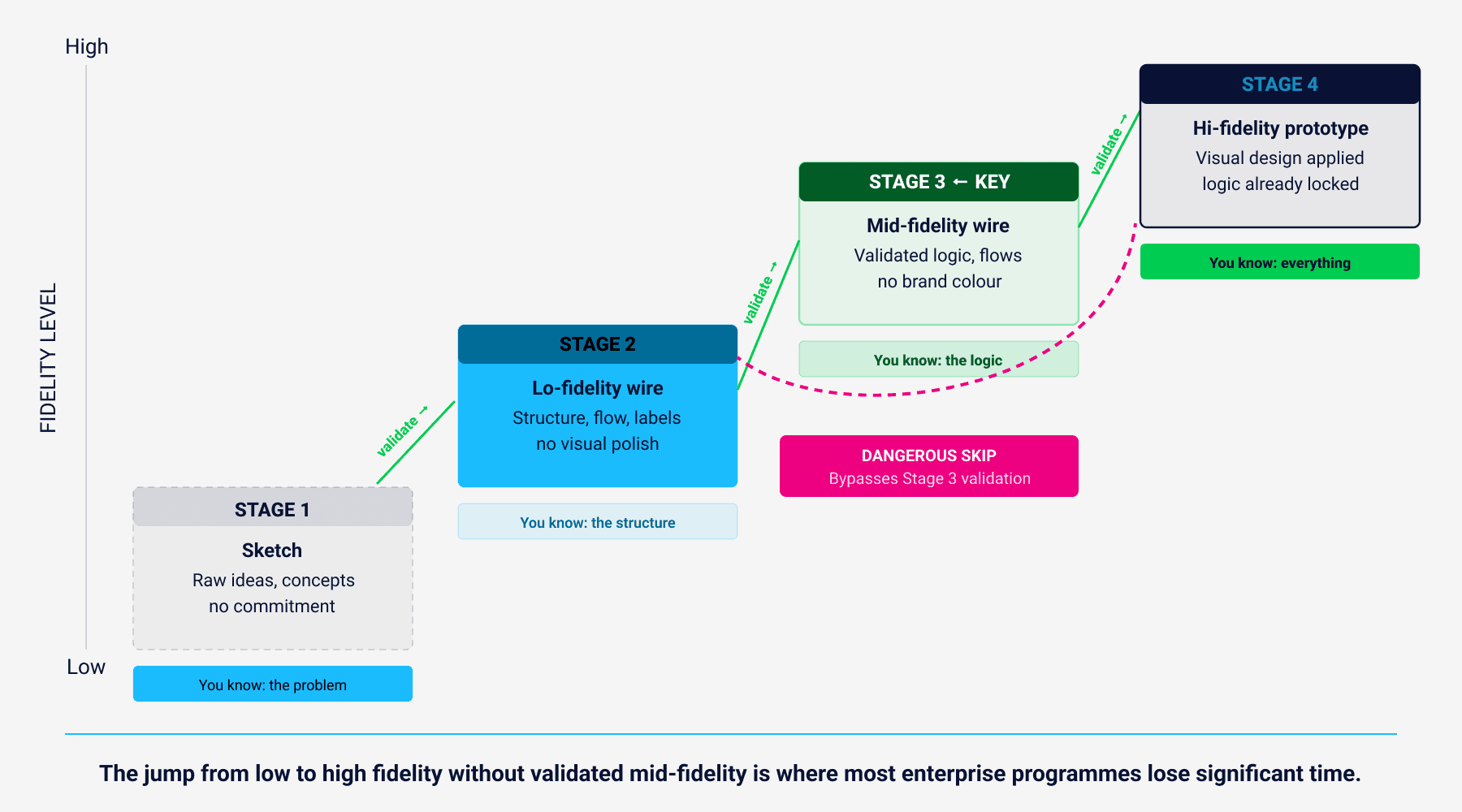
The jump from low to high fidelity without passing through validated mid-fidelity is where most enterprise programmes lose significant time. You skip the stage that catches the mistakes, and you arrive at the execution phase carrying assumptions that should have been challenged three months earlier.
4. Fixing the Problem Is a Governance Decision, Not a Design Decision
You cannot solve a governance failure with better design tools. The issue is not the wireframes themselves it is the conditions under which they are presented, reviewed, and advanced. Fixing this requires deliberate process change at the programme level.
Establish explicit fidelity contracts with stakeholders
Every review session should open with a version declaration: "These wireframes represent logic and flow not final interface design." Simple, but it fundamentally reframes how stakeholders engage. In a banking programme context, this single practice has saved teams from full redesign cycles triggered by executives who mistook a mid-fi artefact for a build-ready spec.
Design roughness intentionally
Low-fidelity artefacts should look unfinished because they are. Roughness gives permission to question. When you present something that visually suggests work-in-progress, stakeholders are more likely to challenge the logic rather than accept the visual. This is a deliberate design decision, not a resource constraint.
Remove real colors. Remove brand typography. Remove polished icons. Make the structure do the talking.
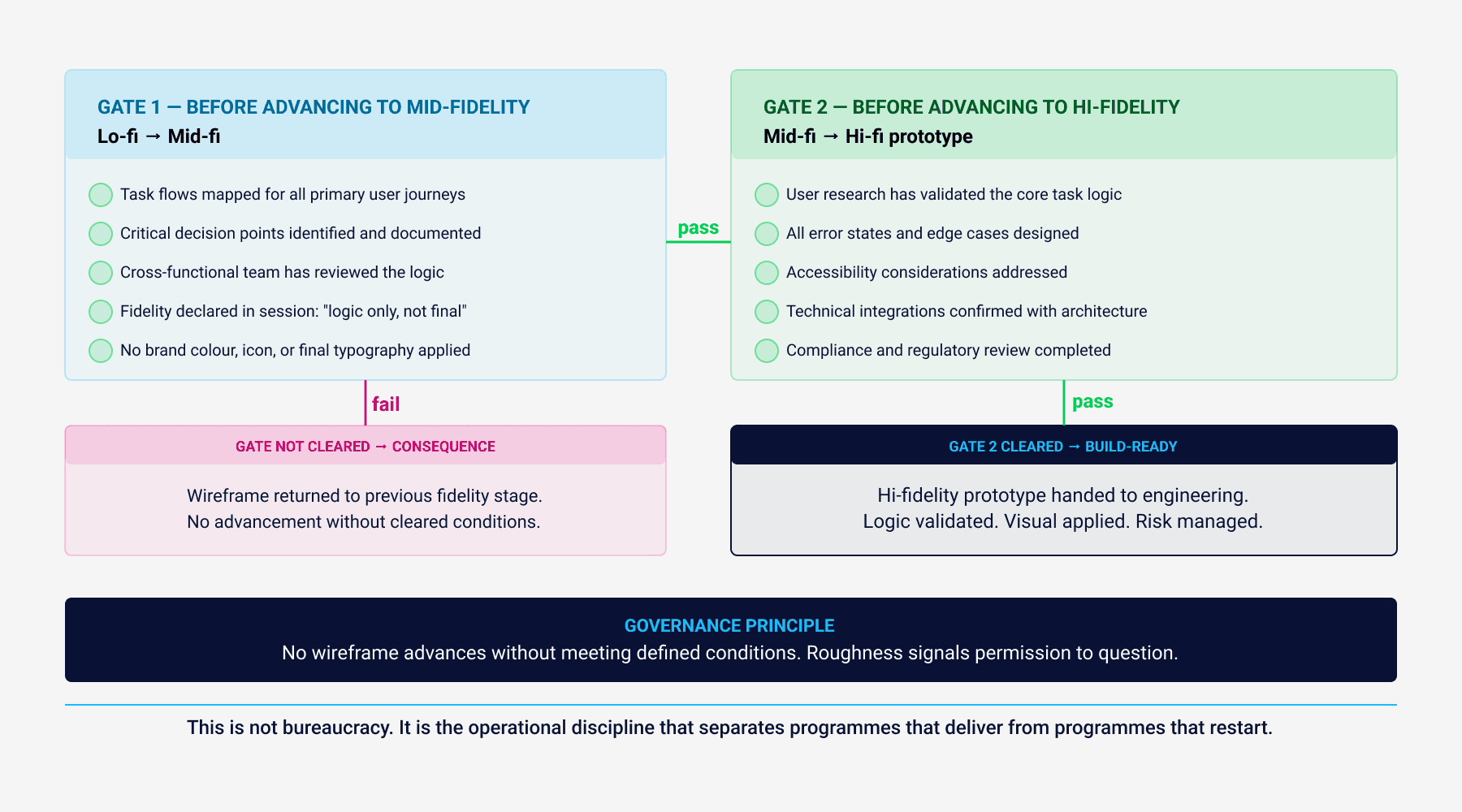
Build advancement gates into your UX governance model
No wireframe should advance to higher fidelity without clearing a set of defined conditions. This is especially critical in government and financial services programmes where downstream decisions carry regulatory weight.
Show the evolution, not just the destination
Stakeholders who only see the final prototype have no context for the decisions it encodes. Showing the progression from sketch to structure to validated prototype builds both comprehension and organisational trust. In a telecom transformation programme, this single practice shifted the executive perception of UX from "the team that makes things look nice" to "the team that manages product risk."
Position UX as the guardian of process integrity
In enterprise environments, UX is not the team that makes things look good. It is the team that ensures things work well and that protecting the fidelity process is part of that responsibility. That means pushing back when stakeholders request premature polish. It means declining to upgrade artefacts until the logic is solid. And it means having the governance language to explain why, in terms that a programme director or compliance officer can act on.
5. The UX Process Flow: What It Should Look Like
For teams operating in regulated environments, the following flow is not aspirational it is the minimum viable process for programmes where mistakes are expensive and reversibility is limited.
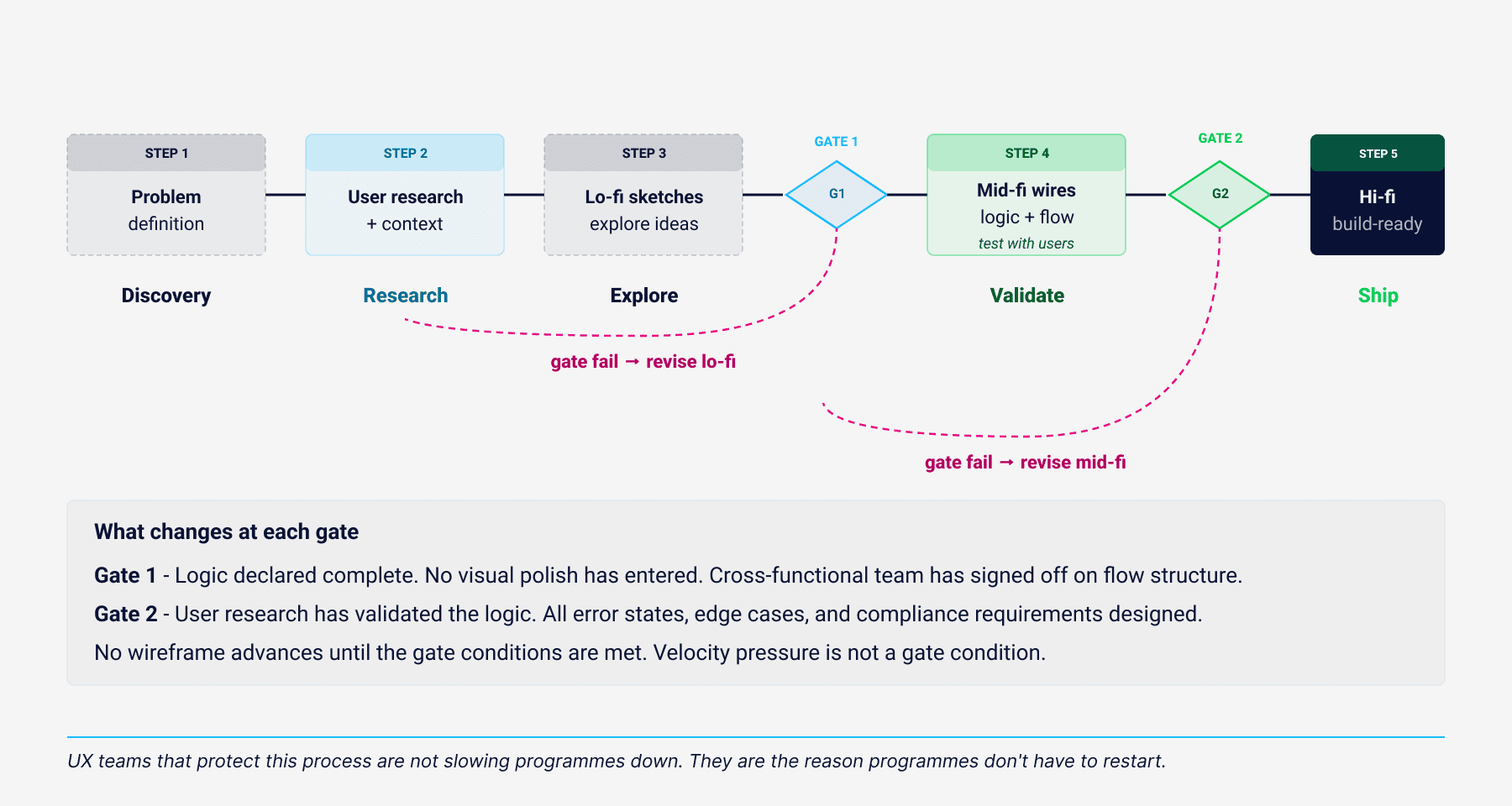
The flow above is not bureaucracy. It is the operational discipline that separates programmes that deliver from programmes that restart.
6. A Reflection for Enterprise UX Leaders
The pressure to show progress is real. In banking and government programmes, delivery milestones carry financial and political weight. Polished wireframes create the
appearance of momentum. But appearance and momentum are not the same thing.
Beautiful wires can convince a programme board that they are further along than they actually are. They can mislead executives, distort research, trap engineering into premature decisions, and in compliance-sensitive environments generate regulatory exposure when unvalidated assumptions make it into production.
Pretty doesn't mean ready. Ready means validated, aligned, and strategically grounded.
In regulated industries, the cost of confusing the two isn't a design revision. It's a programme setback.
CLOSING STATEMENT
UX teams that protect the wireframe process are not slowing programmes down. They are the reason programmes don't have to restart. That distinction needs to be made clearly, early, and loudly especially in organisations where speed is worshipped and validation is treated as a luxury.
About the Author
Chemsseddine SALEM is a Lead UX Designer and Researcher specialising in Enterprise SaaS, UX Governance, Finance, and Energy sectors. He is the founder of Chemss Labs and works with organisations navigating large-scale digital transformation in regulated environments.
About


Featured Posts