The 2026 UX Trends You Need to Prepare For
Discover the 2026 UX trends transforming design AI-driven interfaces, inclusive experiences, and sustainable innovation.

Chemss Salem
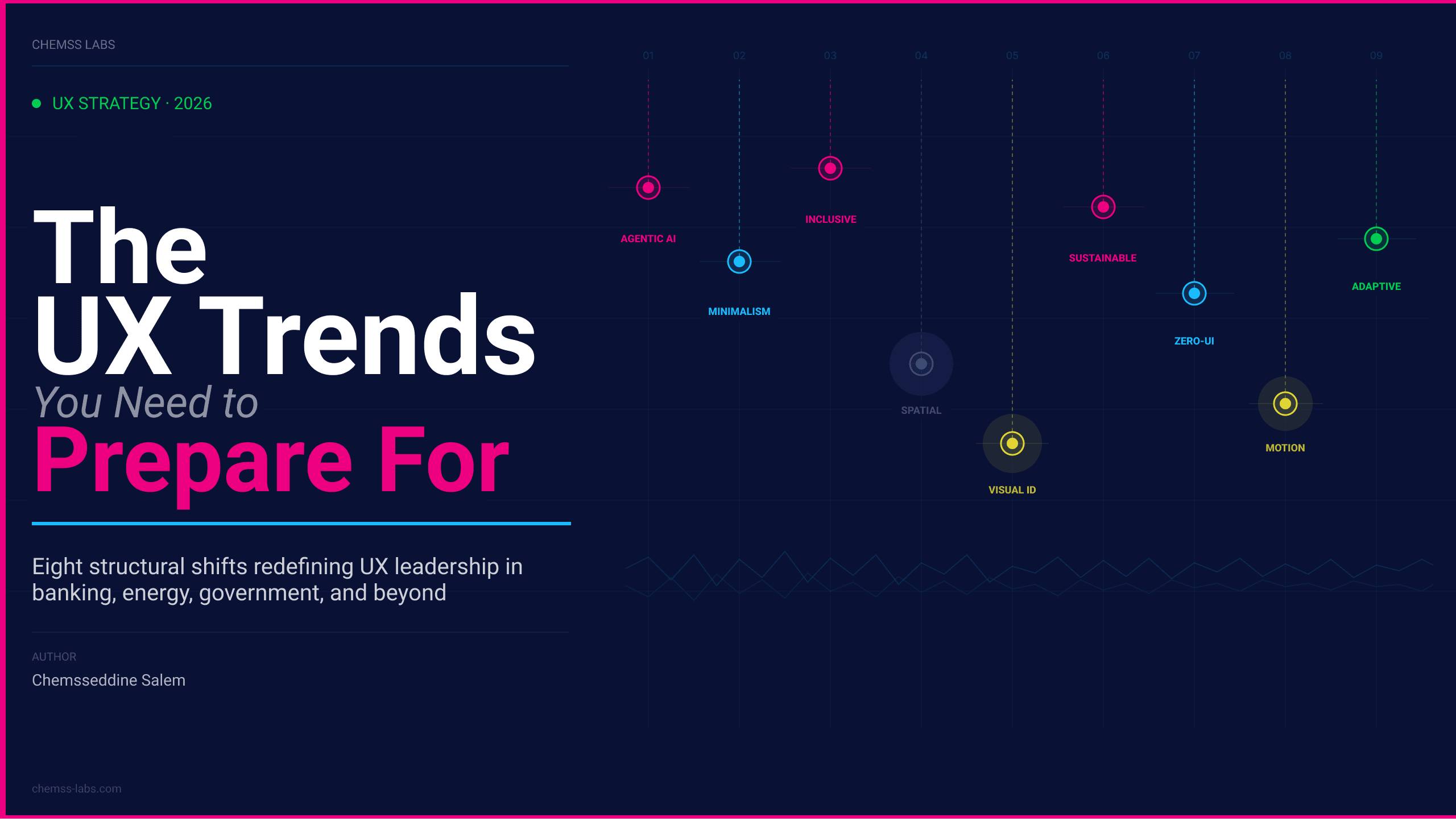
UX has spent a decade proving its value through better interfaces. That argument is over. In 2026, the discipline is being asked to prove something more demanding: whether it can function as strategic infrastructure inside organisations that are simultaneously deploying AI, navigating new regulatory frameworks, and attempting to scale products that were not built to scale.
Eight structural shifts are redefining what UX leadership means. Not all of them require equal attention and not all of them are relevant to every context. What follows is an honest assessment of where the field is moving, what each shift demands from UX teams, and which sectors face the highest exposure if they ignore it.
1. Agentic AI: When the Interface Acts on Behalf of the User
AI has moved from a behind-the-scenes optimisation layer to the primary interaction layer. The shift that matters in 2026 is not AI-powered features those have existed for years. It is agentic AI: systems that do not just respond to user input but act autonomously toward user goals.
A travel platform that books flights without prompting, a compliance dashboard that flags risk before the analyst notices it, a procurement tool that initiates approvals based on learned thresholds in each case, the interface has made a decision. The user arrives after the fact.
This creates a design problem that standard UX methods were not built to solve. Task flows assume a user initiating action. Goal flows assume a system completing action on the user’s behalf. The distinction matters because it relocates accountability. When the system acts, the designer is responsible for whether the user can understand what happened, verify it was correct, and override it if it was not.
In regulated environments credit decisioning, healthcare triage, government benefit processing this is not an abstract ethical question. It is a compliance requirement. Explainability is not a nice-to-have design principle. It is the mechanism by which autonomous systems remain auditable.
What this demands from UX teams: Redesign task flows as goal flows. For every agentic action, design the explanation layer “The system did X because Y” before designing the action itself. Pair UX with data science at discovery, not at handoff.
2. Strategic Minimalism: Cognitive Load as a Design Metric
Minimalism has been aesthetically fashionable for a decade. What is changing in 2026 is why it matters. The case for reduction is no longer primarily visual it is cognitive.
Decision fatigue is measurable. Every unnecessary choice a user confronts carries a cost: time, attention, and the risk of the wrong decision. In high-stakes enterprise environments trading interfaces, clinical systems, regulatory compliance tools that cost is not trivial. A badly designed confirmation dialog in a fund transfer flow is not an inconvenience. It is a risk event.
Strategic minimalism means auditing interfaces for decisions-per-flow, not components-per-screen. It means applying progressive disclosure not as a layout technique but as a cognitive load management strategy. And it means removing interface elements that exist because of internal process logic rather than user need a category of clutter that enterprise systems accumulate silently over years.
Apple’s iOS Shortcuts architecture is a useful reference: complex automation logic hidden behind a single interaction point. Users experience capability without confronting complexity. That is the design target.
What this demands from UX teams: Introduce cognitive load auditing as a standard research method. Measure decisions-per-flow as a KPI alongside task completion. Establish a review process for removing, not just adding, interface elements.
3. Neurodiverse and Inclusive Design: From Compliance to Competitive Advantage
The framing of accessibility as a compliance obligation has always been strategically incomplete. Designing for neurodiversity, ADHD, dyslexia, autism spectrum produces interfaces that are more comprehensible for everyone. Reduced motion, clearer information hierarchy, plain-language microcopy, and sensory-load reduction are not accommodations. They are quality standards.
WCAG 3.0 and the EU Accessibility Act are raising the regulatory floor in 2026. But the competitive argument is more durable than the regulatory one. Banking and insurance platforms that are genuinely easier to use for users with cognitive variation retain customers that competitors lose to friction.
Microsoft’s Inclusive Design Toolkit (updated 2025) is the current benchmark for enterprise applications. The BBC Sounds approach, text-to-speech navigation, minimal-motion modes, density controls, demonstrates that inclusive patterns are entirely compatible with sophisticated product design.
What this demands from UX teams: Run usability studies with cognitively diverse participants, not just representative demographic samples. Embed inclusive tokens in the design system, motion settings, contrast modes, density controls, as first-class components, not afterthoughts. Train content teams in plain-language standards; the content problem is as significant as the interface problem.
4. Spatial and Immersive UX: Designing for Depth, Distance, and Gesture
Apple Vision Pro, Meta Quest 3, and the AR glasses category are making spatial interaction a viable UX design surface in 2026. This is not a mass-consumer shift yet. It is a specialist one and the sectors that will feel it earliest are the ones that deal in physical environments: energy infrastructure, healthcare, retail, manufacturing.
The design shift is fundamental. Spatial UX does not operate in pixels. It operates in depth, distance, gesture, and physical context. A field technician using AR overlays on energy infrastructure equipment does not need a beautiful interface, they need information precisely positioned relative to physical objects, with zero ambiguity about what to act on next.
IKEA Place demonstrates the consumer version: furniture previewed at accurate scale in a user’s own space. The design work is not the AR, it is the decision about what information reduces uncertainty and at what moment.
What this demands from UX teams: Start prototyping in spatial environments now, even if production timelines are distant. The spatial design competencies required comfort, reference frames, gesture vocabularies take time to develop. Always build a 2D fallback; spatial UX should extend capability, not restrict it.
5. Authentic Visual Identity: Character as a Strategic Differentiator
A decade of convergence toward flat, minimal, template-derived visual design has produced a recognisable problem: every product looks the same. In 2026, visual differentiation is a strategic position, not an aesthetic one.
The shift is toward interfaces that express deliberate character asymmetry, expressive typography, textural detail, intentional imperfection. This is not anti-design. It is the recognition that visual consistency across an industry signals nothing. Visual distinctiveness, executed with the same rigour as usability, creates brand recall and emotional differentiation that no feature set can replicate.
Figma’s 2025 redesign introduced micro-glitches and expressive colour breaking the flat-minimal pattern deliberately. Notion’s marketing uses hand-drawn elements to signal warmth. These are not accidental aesthetic choices. They are strategic communication decisions.
The risk in this shift is obvious: expressive design executed without rigour produces chaos. The differentiating factor is the design system whether visual personality traits are documented, governed, and tested against usability standards with the same discipline as any other component.
What this demands from UX teams: Run brand workshops that produce emotional design briefs, not just visual guidelines. Document visual personality traits as system tokens. Test expressive design against accessibility standards contrast ratios and motion safety do not negotiate with aesthetics.
6. Responsible and Sustainable UX: Efficiency as Ethics
The environmental cost of digital products is no longer abstract. Data transfer has a carbon cost. Unoptimised interfaces heavy video, redundant API calls, unnecessary render cycles carry an energy cost that aggregates at scale to something measurable and attributable.
This matters in 2026 for two reasons that are not primarily ethical. First, streamlined UX is faster UX, and faster UX performs better and retains users better. The sustainability and performance arguments are the same argument. Second, ESG reporting requirements in major markets are extending to digital operations, and organisations that have no measurement framework for digital environmental impact will face that gap in regulatory contexts.
Google Search’s carbon-per-query reduction demonstrates that environmental optimisation and product quality optimisation are the same activity. The design decisions that reduce carbon leaner assets, efficient flows, reduced interaction overhead are also the decisions that improve speed and comprehension.
What this demands from UX teams: Add environmental metrics to the analytics stack data transfer per session, render weight, unnecessary interaction steps. Remove dark patterns: forced consent flows, infinite scroll, friction-by-design are simultaneously bad ethics and bad UX. They are also increasingly legally exposed.
7. Hyper-Personalisation and Zero-UI: Designing for Invisible Interaction
The endpoint of personalisation is an interface that does not look like one. Zero-UI voice, gesture, biometric response, environmental sensors removes the screen as the primary interaction surface. The design challenge shifts from how it looks to whether it works and whether it can be trusted.
Spotify’s DJ feature is a current example: AI-curated playlists delivered through voice in a conversational register. Tesla’s cabin UX adjusts environmental settings without user input. In both cases, the interface has become the system’s behaviour, and the designer’s responsibility is the quality of that behaviour its accuracy, its transparency, and its recoverability when wrong.
In enterprise contexts, zero-UI has specific relevance in operational environments: energy control rooms, field service, clinical settings where screen interaction is constrained by physical context. Voice and gesture interaction in these environments is not a consumer convenience feature. It is a capability that changes what is operationally possible.
What this demands from UX teams: Map high-friction user moments where ambient interaction could replace screen interaction. For every zero-UI feature, design the recovery path what happens when the system is wrong, and how the user corrects it without friction. Privacy architecture must be co-designed with UX, not added after.
8. Motion and Micro-Interaction: The UX of Sub-Second Experience
Motion design has moved from decoration to communication. In 2026, the organisations that use motion well treat it as a vocabulary with grammar defined durations, easing curves, and behavioural logic not a layer applied after the interaction is designed.
Airbnb’s motion language is the standard reference: transitions that communicate spatial relationship and hierarchy, animations that follow physical logic, micro-interactions that confirm system state without requiring the user to look for confirmation. The result is not beauty. It is reduction in cognitive uncertainty the user always knows where they are and what just happened.
The discipline issue is consistency. Motion defined in isolation by individual designers produces incoherence. Motion defined in the design system as a set of tokens and rules produces a product that feels unified, regardless of how many teams contributed to it.
What this demands from UX teams: Define a motion grammar in the design system: durations, easing curves, state-change patterns, haptic triggers. Always ship a reduced-motion alternative as a default-accessible path. Test motion against cognitive load, not just visual preference in high-density information environments, motion that is not tightly purposeful is noise.
9. Data-Driven and Adaptive UX: Continuous Design as an Operating Model
The last structural shift is not a design trend. It is a change to the operating model of design itself. Adaptive UX treats the product as a continuous system, not a series of handoff artefacts. Interfaces evolve through live telemetry, user context signals, and controlled experimentation not through periodic redesign cycles.
Netflix’s thumbnail personalisation testing image variants per viewer persona produced a 20% increase in click-through. Figma’s component analytics track reuse patterns to identify design system failures. In both cases, design decisions are governed by evidence that did not exist at design time.
For enterprise UX teams, this requires infrastructure: telemetry embedded in prototypes and production, UX researchers integrated with data analysts, and defined thresholds for when the system adapts autonomously versus when a designer intervenes. Without those thresholds, adaptive UX becomes invisible product drift changes accumulating without governance.
What this demands from UX teams: Embed telemetry at the prototype stage, not just in production. Define what the system is permitted to adapt and what requires designer review. Distinguish personalisation from surveillance in the data architecture, and make that distinction visible to users.
Preparing Your Organisation
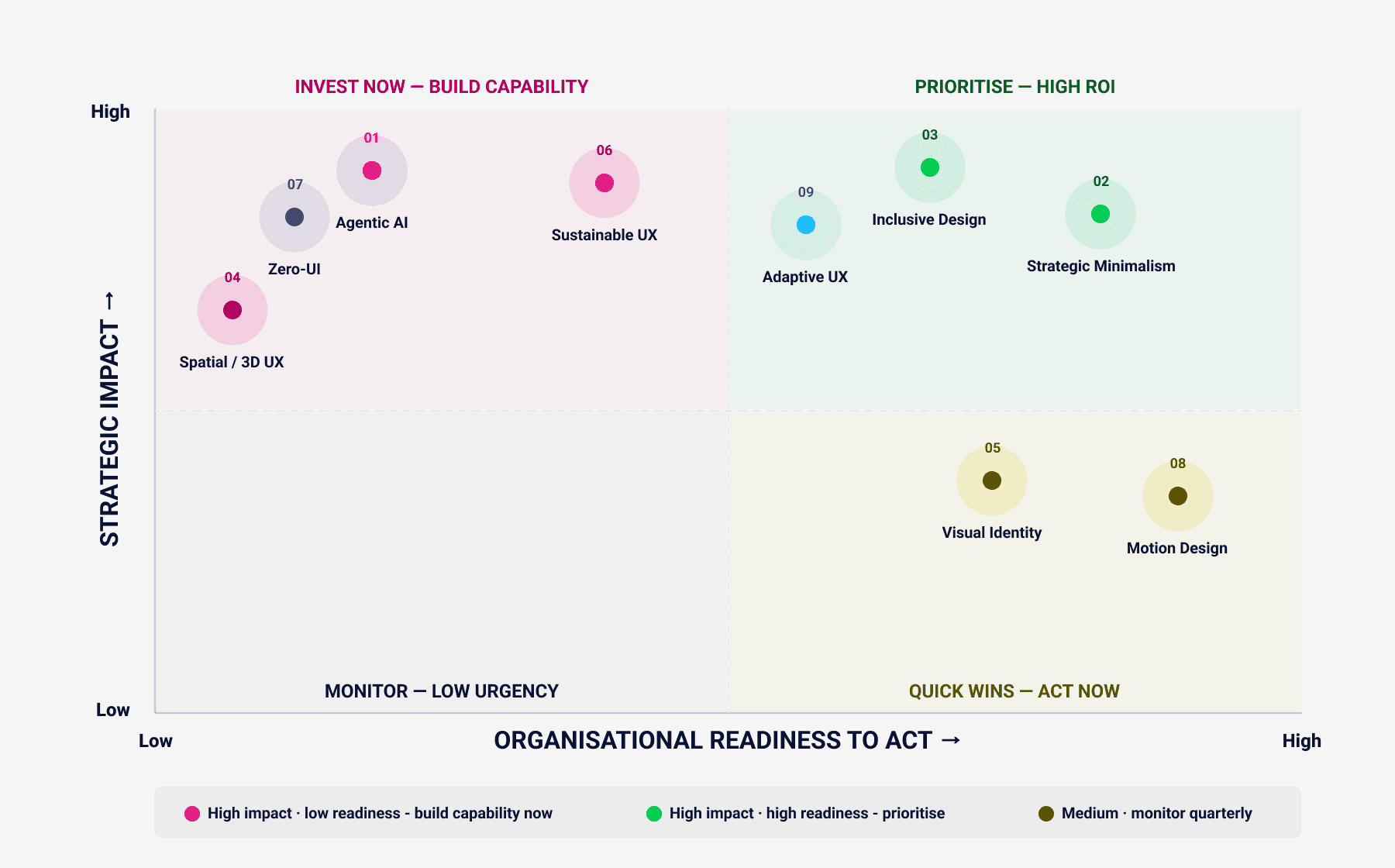
Not every trend requires equal urgency. The right prioritisation depends on sector, current design system maturity, and where regulatory exposure is highest.
For organisations in financial services, energy, or government, the highest-priority shifts are the ones with direct regulatory implications: agentic AI explainability, inclusive design standards, sustainability metrics, and adaptive UX governance. These are not optional investments ahead of coming compliance cycles. They are the ones where delayed action produces the most expensive correction.
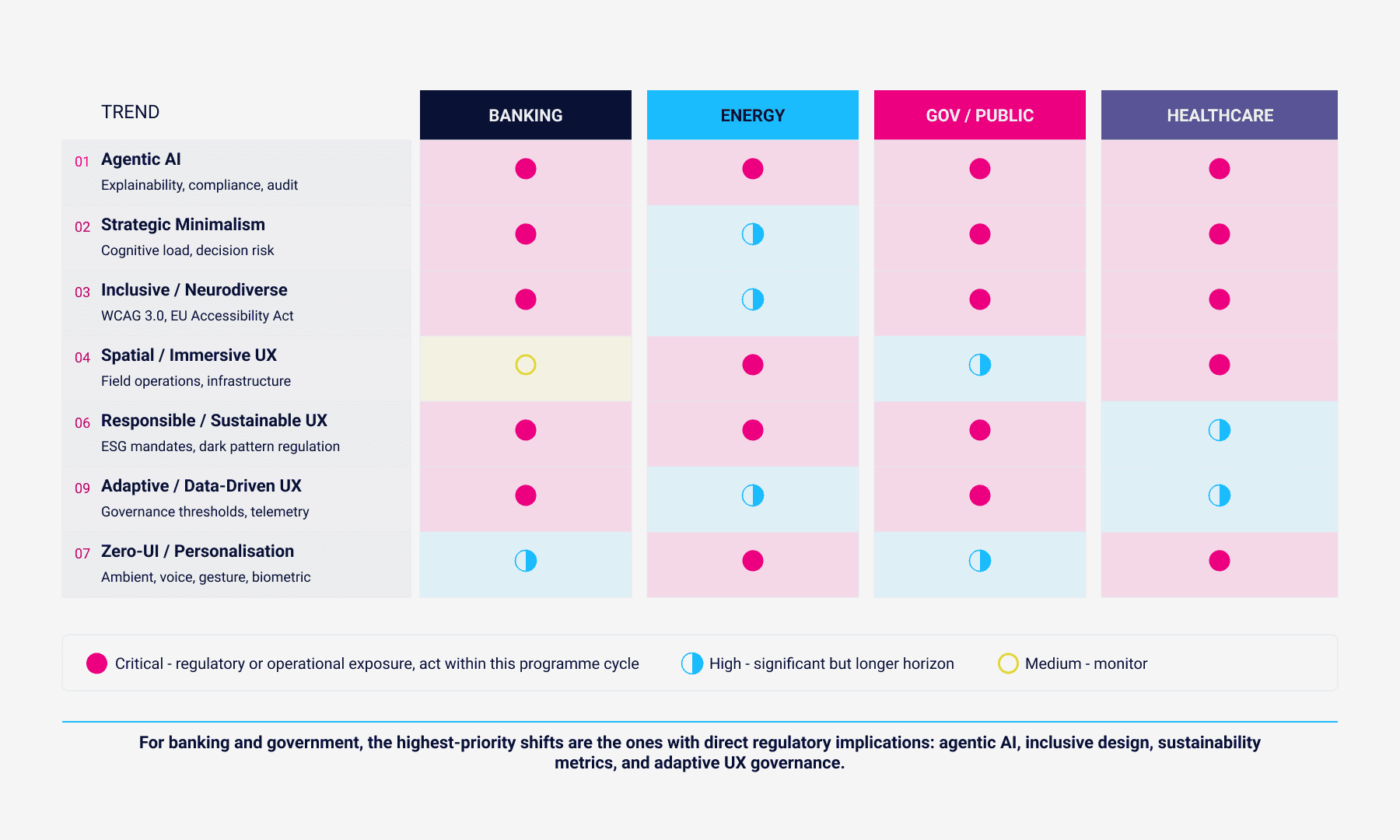
The capability requirement that cuts across all nine trends is the same one that has always separated effective UX from decorative UX: governance fluency. The ability to frame design decisions in the language of risk, compliance, and business continuity and to maintain design quality standards at delivery velocity is what determines whether UX operates at the strategic layer or gets managed around it.
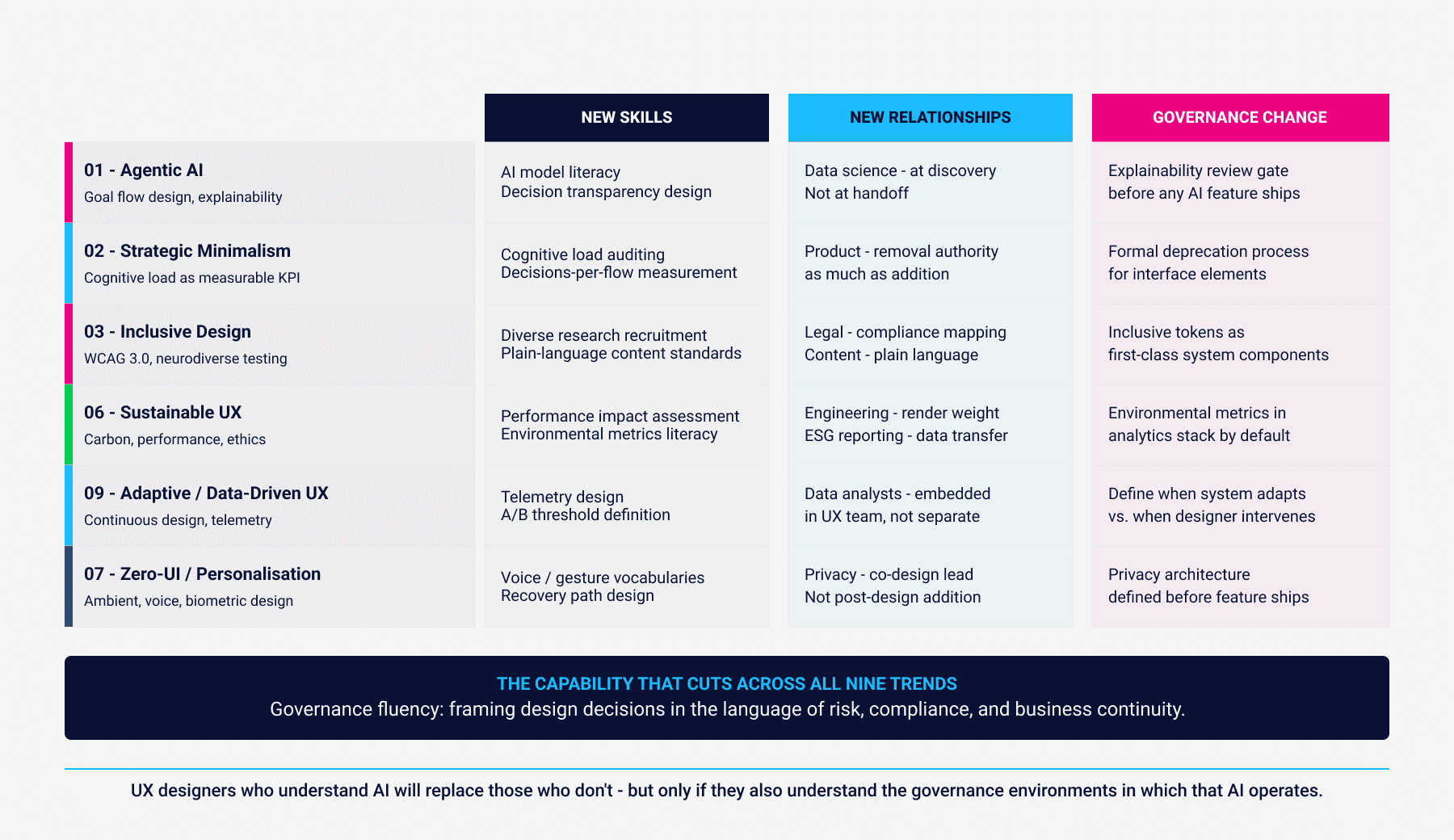
Design systems that evolve, research operations that persist across project cycles, and UX teams that speak the language of programme governance are not aspirational states. They are the operational preconditions for relevance in 2026.
About the Author
Chemsseddine SALEM is a Lead UX Designer and Researcher specialising in Enterprise SaaS, UX Governance, Finance, and Energy sectors. He is the founder of Chemss Labs and works with organisations navigating large-scale digital transformation in regulated environments.
About


Featured Posts